





Detroit warehouses are losing money every shift. Manual inventory counts that eat up entire workdays, stockouts that kill customer relationships, and shipment errors that drain profit margins. The good news? The solution is already within reach: a reliable internet connection and the smart technology that depends on it.
Metro Detroit’s warehouse labor force of 67,322 workers is expected to grow 6.7% by 2033, with major distribution centers clustered along the I-275 corridor, in Romulus near Detroit Metropolitan Airport, and across Wayne, Oakland, and Monroe counties. At that scale, the difference between a connected warehouse and a disconnected one is measured in millions of dollars.
This guide breaks down exactly how internet-powered inventory technology works, what it costs, what it saves, and how Detroit warehouse operators can start today.
The Evolution of Warehouse Technology
Warehousing has changed more in the past decade than it did in the previous five. The shift from clipboards and spreadsheets to real-time digital tracking was not driven by preference; it was driven by competitive necessity. E-commerce growth, tighter automotive supply chains, and rising labor costs have forced Detroit’s distribution and manufacturing facilities to modernize or fall behind.
The entire smart warehouse technology ecosystem depends on a single foundation: a fast, stable, and redundant internet connection. Without it, even the most expensive sensors and scanning equipment becomes useless. Explore Cronus Internet’s business internet solutions to understand what enterprise-grade connectivity looks like for industrial facilities in Detroit.
RFID and Barcode Scanning Systems
Barcode scanning has been around for decades, but modern implementations are a far cry from the handheld guns of the 1990s. Today’s warehouse barcode systems integrate directly with warehouse management software, automatically updating inventory records in the cloud the moment a scan occurs.
Radio Frequency Identification (RFID) takes this further. Unlike barcodes that require direct line-of-sight, RFID tags can be read simultaneously from multiple items without individual scanning, dramatically reducing the time required for inventory audits. A manual inventory process that takes eight hours with traditional barcodes typically takes 30 to 45 minutes with RFID, a reduction of approximately 94%.
RFID systems in well-implemented warehouses consistently achieve 95 to 99% inventory accuracy, compared to 65 to 75% accuracy with manual methods. For a Detroit distribution center handling thousands of SKUs for automotive suppliers or logistics partners, that accuracy gap has a direct dollar value.
Real-Time Inventory Tracking
Real-time tracking means that when a pallet moves from receiving to storage to shipping, every system that needs to know about it knows immediately. There is no lag, no batch update at end of shift, and no reconciliation headache at month-end.
This matters enormously for Detroit’s automotive sector, where Tier 1 suppliers for GM, Ford, and Stellantis operate on just-in-time delivery models. A single missed scan or delayed inventory update can halt an assembly line. IoT devices integrated into warehouse systems allow facility managers to make decisions instantly and avoid costly delays and downtime.
Real-time tracking also enables better demand forecasting. When inventory movement data flows continuously into analytics platforms, operators can identify slow-moving stock, predict replenishment needs, and respond to demand shifts before they become problems.
Internet Infrastructure for Smart Warehouses
Technology is only as reliable as the network it runs on. This is where many Detroit facilities encounter their first real obstacle: the existing internet infrastructure either was not built to support dozens of connected devices, or it suffers from dead zones and congestion that make real-time data transfer unreliable.
Cronus Internet has operated out of Detroit since 2008 as the first and only privately held internet service company based in the city. With enterprise-class fiber and fixed wireless solutions, Cronus provides the kind of connectivity that smart warehouse systems actually require.
WiFi Coverage for Large Facilities
A warehouse is one of the most challenging environments for wireless networks. High ceilings, metal shelving, forklifts, and large open spaces create interference, signal degradation, and coverage gaps. A consumer-grade router near the office does not serve a 200,000-square-foot floor.
Effective warehouse WiFi requires:
- Access points mounted at appropriate heights and intervals to eliminate dead zones
- Sufficient bandwidth to handle dozens of simultaneous scanning devices, management terminals, and IoT sensors
- Network segmentation to separate operational traffic from administrative traffic
- Redundancy to maintain connectivity if a single access point fails
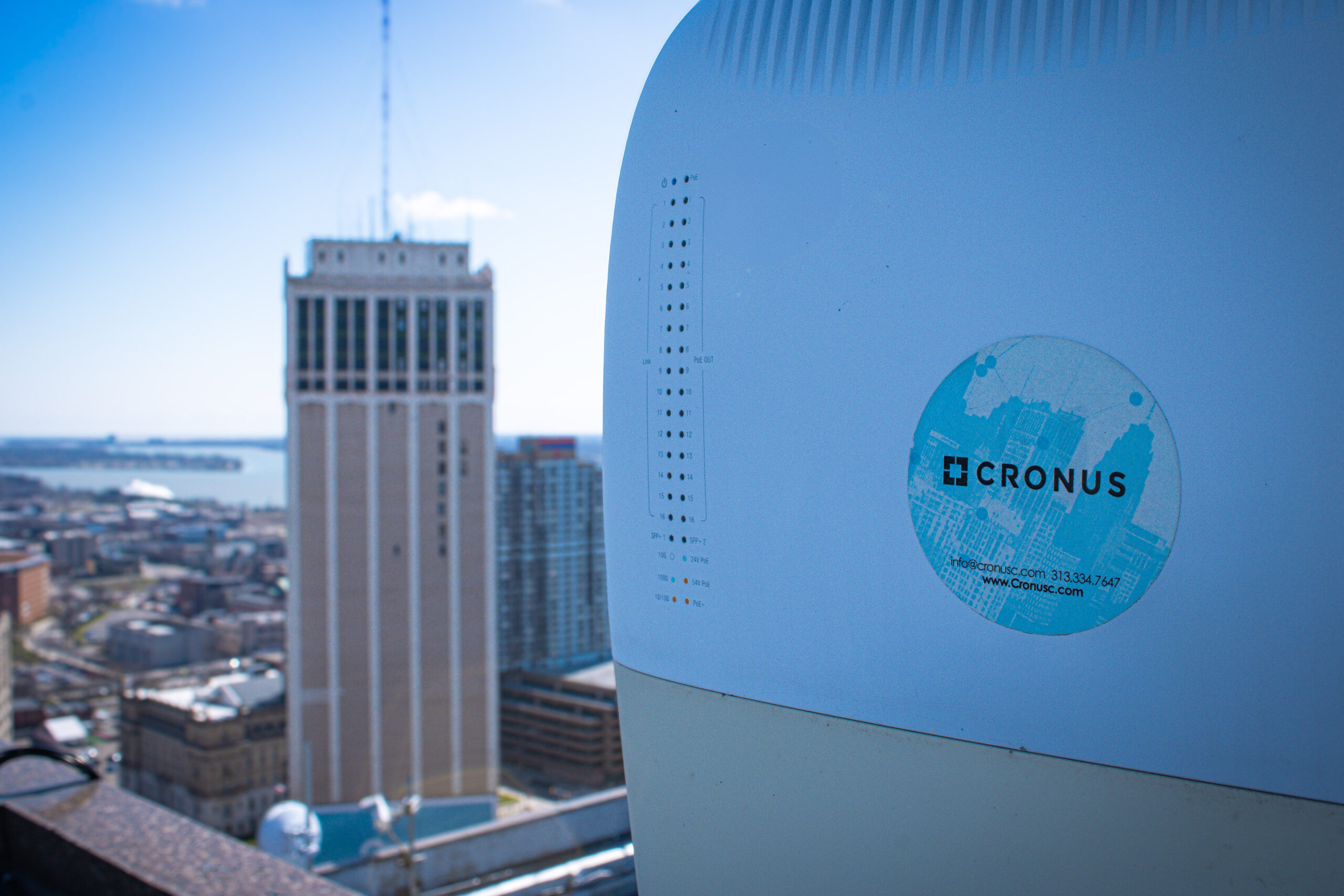
Cronus Internet’s fixed wireless service delivers speeds up to 10 Gbps via a microwave connection between two fixed points, with no data limits and a 99.99% SLA. For large facilities where running fiber to every corner is impractical, fixed wireless provides a cost-effective way to blanket the entire space with reliable connectivity.
Cronus also offers SD-WAN solutions that add a critical layer of resilience. When a primary connection falters, SD-WAN automatically routes traffic through a backup connection, ensuring operations never stop. For warehouses where a dropped connection could cause inventory data to fall out of sync during a critical shipping window, this redundancy is essential.
Integration with Transportation Systems
Modern warehouse operations do not end at the loading dock. Inventory management systems increasingly integrate with transportation management platforms and carrier APIs, enabling automatic shipment scheduling, real-time carrier tracking, and electronic proof of delivery.
Wide Area Networks enable businesses to communicate across locations and share information with customers and business collaborators without geographic restriction. For a Detroit distribution center feeding parts to multiple assembly plants across the region, WAN connectivity enables seamless coordination between the warehouse floor and outbound logistics.
This integration also applies to inbound operations. When a supplier updates their shipping status, a WAN-connected inventory system can automatically adjust receiving schedules, allocate dock doors, and notify picking teams of incoming stock before the truck arrives.
ROI Analysis of Connected Warehouse Systems
The question warehouse operators ask most often is not whether smart inventory technology works; it is whether the investment pays off. The data on this is consistent.
Organizations implementing RFID-powered inventory systems report up to a 30% cut in inventory management costs by improving tracking accuracy and speeding stocktakes. Most warehouses achieve a full return on their technology investment within 18 to 36 months.
Labor Cost Reductions
Labor is typically the largest expense in warehouse operations. Smart inventory technology affects labor costs in several measurable ways.
First, it eliminates manual counting. Physical inventory counts that once required multiple staff members working for hours can be completed in a fraction of the time with RFID. Those hours can be redirected to productive activity or eliminated from the labor schedule entirely. A 2024 study by Roland Berger found that implementation of smart warehouse automation technology led to cost reductions of 20% to 40% and productivity improvements of 25% to 70%.
Second, it reduces error correction. Every picking error generates a downstream cost: a customer complaint, a return shipment, a replacement order, and staff time spent resolving the issue. Higher scan accuracy means fewer errors from the start. Research on RFID deployment in warehouses indicates that most facilities achieve 25% to 40% labor reduction as a direct result of automated tracking and reduced manual data entry.
Inventory Accuracy Improvements
Inaccurate inventory is expensive in ways that do not always show up clearly on a balance sheet. Overstock ties up working capital and warehouse space. Stockouts lose sales and damage customer relationships. Shrinkage from undetected errors compounds over time.
RFID inventory tracking consistently achieves 95 to 99% accuracy in well-implemented systems, compared to the 65 to 75% typical of manual tracking. That improvement translates to fewer stockouts, less excess inventory, and more accurate financial reporting. Retailers implementing RFID also report up to 50% reduction in shrinkage, making it one of the strongest ROI drivers for facilities handling high-value automotive components or electronics.
Ready to build the connectivity foundation your warehouse needs? Contact Cronus Internet for a custom quote and find out how Detroit’s local internet provider can support your smart warehouse goals.
Implementation Planning for Existing Facilities
Upgrading an existing facility is different from designing a smart warehouse from scratch. The technology decisions must account for existing infrastructure, workflows, and the reality that operations cannot simply pause during a transition.
A practical implementation path follows three phases.
Phase 1: Connectivity Assessment and Upgrade. Before any inventory technology is deployed, the underlying internet infrastructure must be evaluated. This means mapping WiFi coverage across the full facility floor, testing bandwidth under peak operational load, and identifying redundancy gaps. If connectivity is inconsistent or insufficient, the technology investment built on top of it will underperform. Visit the Cronus Internet news page for guidance on evaluating and upgrading your business network in Detroit.
Phase 2: Pilot Deployment. Introduce scanning and tracking technology in a single zone or department before expanding facility-wide. This allows teams to learn the system, identify integration issues with existing warehouse management or ERP platforms, and build the internal processes that support the technology.
Phase 3: Full Deployment and Optimization. Scale the solution across the full facility, connect inventory data to transportation and procurement systems, and establish ongoing reporting practices that turn raw data into operational decisions.
For facilities where traditional installation is impractical, Cronus Internet’s fixed wireless service requires only a rooftop antenna and no construction, significantly simplifying the connectivity upgrade step.
Warehouse Connectivity Assessment
Before committing to inventory technology investments, consider the following questions about your current infrastructure:
- Does WiFi coverage reach every area of your facility where scanning or sensor activity will occur?
- During peak operating hours, is bandwidth sufficient to handle all connected devices without congestion?
- If your primary internet connection goes down, does your facility have a failover connection?
- Are your internet speeds sufficient for cloud-based warehouse management or ERP access across multiple simultaneous users?
If the answers reveal gaps, addressing connectivity first protects the rest of your technology investment. Contact the Cronus Internet team for a consultation on business internet solutions built for Detroit’s industrial sector.
Frequently Asked Questions: Warehouse Internet in Detroit
What internet speed does a smart warehouse actually need?
This depends on the number of connected devices and the volume of data being transferred. A facility with 20 scanning devices, a cloud-based warehouse management system, and IP cameras should have a minimum of 100 Mbps dedicated to operations, with burst capacity available for peak periods. Cronus Internet’s business internet offerings range from 50 Mbps to 10 Gbps, allowing facilities to right-size their connection and scale as operations grow.
How much does RFID warehouse implementation cost?
A complete RFID deployment for a small warehouse typically starts between $50,000 and $150,000, covering hardware, software, and integration. Larger facilities can range to $500,000 or more. Most operators achieve full payback within 18 to 36 months through labor savings and improved inventory accuracy.
Does fixed wireless internet work in metal warehouse buildings?
Yes. Cronus Internet’s fixed wireless technology delivers high-speed internet via a microwave connection to a rooftop antenna, bypassing interference inside the building. Internal WiFi distribution is then handled through access points strategically positioned to provide full floor coverage.
What happens if the internet goes down during warehouse operations?
This is exactly why redundancy matters. Cronus Internet’s SD-WAN solutions support multiple simultaneous internet connections, automatically routing traffic through a backup connection if the primary fails. For warehouses integrated with just-in-time supply chains, this failover capability is critical.
Is Cronus Internet available for warehouse facilities outside the city of Detroit?
Yes. Cronus Internet operates across Metro Detroit and Michigan, serving businesses in Wayne, Oakland, and Macomb counties and beyond. Their fixed wireless network uses microwave technology that can reach locations where fiber installation would be cost-prohibitive.
How does a reliable internet connection affect warehouse labor costs?
A stable, high-speed connection allows scanning systems, inventory platforms, and warehouse management software to operate without interruption. When these systems work as designed, workers spend less time troubleshooting, re-scanning failed reads, or waiting for slow cloud applications to respond. Research shows warehouses using connected inventory systems achieve 25% to 40% labor cost reductions compared to manual processes.
The Bottom Line on Warehouse Internet in Detroit
Detroit’s industrial market is active and competitive. Warehouse and distribution operators across the region are under consistent pressure to cut costs, improve accuracy, and serve customers faster. The technology to do all three exists today, and the investment pays back within two to three years.
The first step is getting the foundation right. A smart warehouse built on unreliable internet will always underperform. A smart warehouse built on enterprise-grade connectivity runs the way it was designed.
Whether you are upgrading an existing facility or planning a new one, Cronus Internet brings the local expertise, enterprise infrastructure, and responsive service that Detroit businesses rely on. Request a quote today and build a warehouse operation that runs faster, costs less, and stays ahead of the competition.