




Making the Right Internet Choice for Your Michigan Business
Fixed wireless providers and fiber internet that Michigan businesses rely on are transforming how companies operate across the state. Whether you’re running a manufacturing facility in Detroit, managing a retail chain in Grand Rapids, or operating a tech startup in Ann Arbor, choosing between these two powerful connectivity solutions can significantly impact your bottom line.
With fixed wireless speeds reaching up to 10Gbps and fiber pushing boundaries at 1Tbps according to service providers in Michigan, both technologies offer enterprise-grade performance that businesses need to compete in today’s digital economy. But which solution best fits your specific business requirements, timeline, and budget?
Understanding Fixed Wireless Internet for Business
How Fixed Wireless Works
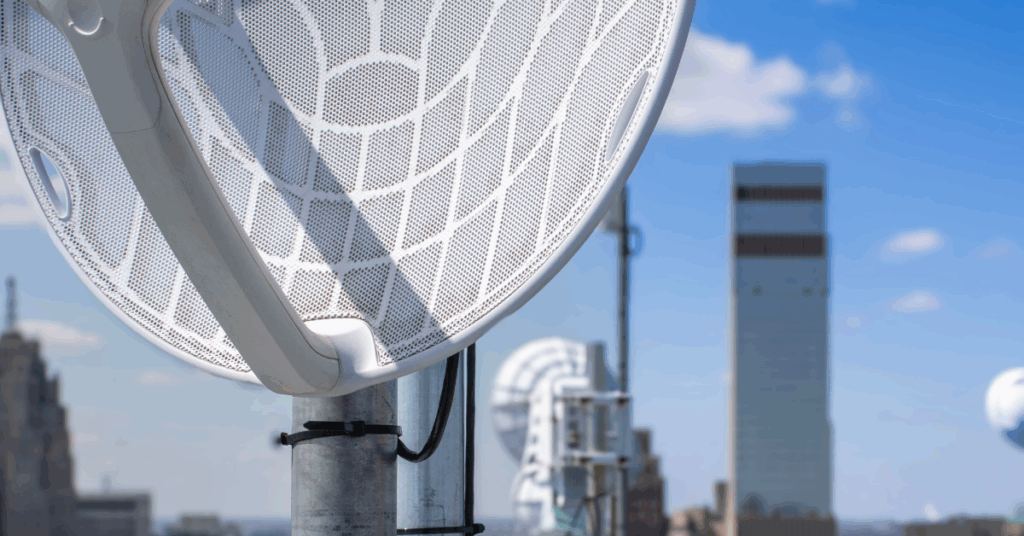
Fixed wireless internet delivers high-speed data via microwave connections between two fixed points, typically adding an antenna to your rooftop to establish connectivity. Unlike satellite internet that beams signals from space, fixed wireless uses ground-based towers positioned strategically throughout Michigan communities, transmitting radio signals from base stations to receivers at fixed business locations.
The technology creates point-to-point or point-to-multipoint connections, eliminating the need for physical cable infrastructure while maintaining professional-grade reliability. According to the FCC’s broadband progress reports, this approach has proven particularly effective in reaching underserved Michigan businesses.
Speed and Performance Capabilities
Michigan businesses accessing fixed wireless through providers like Cronus can experience remarkable performance metrics:
- Download/Upload Speeds: Up to 10Gbps symmetrical speeds
- Latency: Low latency comparable to fiber connections, ideal for real-time applications
- Weather Resistance: Service withstands extreme conditions, including heavy rain, snow, high winds, and severe temperature fluctuations, without disrupting quality
Installation Timeline and Process
Standard installations are complete within 7-14 days, while licensed installations requiring special permits finish in 30-45 days. The installation process involves:
- Site survey within five business days of ordering
- Rooftop antenna installation
- Interior equipment setup
- Network configuration and testing
This rapid deployment makes fixed wireless particularly attractive for businesses needing immediate connectivity or temporary solutions during construction projects.
Exploring Fiber Internet Michigan Options
Fiber Optic Technology Explained
Fiber optic internet transmits data using light through small glass or plastic cables, allowing for nearly instantaneous data transmission, downloading, and uploading. This revolutionary technology, as described by the Institute of Electrical and Electronics Engineers (IEEE), represents the gold standard for business connectivity.
Performance Specifications
Michigan fiber networks deliver exceptional capabilities according to Cronus’s fiber internet services:
- Maximum Speeds: Up to 400 Gbps for business connections with symmetrical speeds
- Symmetrical Performance: Equal upload and download speeds are crucial for cloud applications
- Reliability: 99.9% uptime guarantees with weather-immune underground cable infrastructure
Availability Across Michigan
Approximately 44.11% of Michigan has fiber availability, with coverage concentrated in the southeast regions. Business internet providers continue expanding networks, with providers adding three buildings daily to fiber infrastructure, according to industry reports.

Head-to-Head Comparison: Key Decision Factors
Installation Speed Winner: Fixed Wireless
When time equals money, fixed wireless dominates the installation race. While fiber installations can take six months or more for buildings without existing infrastructure, fixed wireless connects businesses within weeks. For Michigan businesses facing:
- Urgent relocation deadlines
- Seasonal business launches
- Construction site connectivity needs
- Temporary event requirements
Fixed wireless provides the rapid deployment essential for maintaining operations, as detailed in Cronus’s fixed wireless overview.
Cost Analysis: Understanding Total Investment
Fixed wireless typically costs less due to minimal infrastructure requirements, avoiding expensive cable laying and construction permits. Consider these financial factors:
Fixed Wireless Costs:
- Avoids material expenses, construction costs, and permitting delays
- No construction or trenching expenses
- Reduced permit requirements
- Faster return on investment
Fiber Investment:
- Higher upfront infrastructure costs
- Potential construction fees
- Long-term value through unlimited scalability
- Lower per-gigabit costs at maximum speeds
The Gartner TCO methodology, which introduced TCO analysis in 1987, recommends evaluating total cost of ownership over 3-5 years when comparing connectivity options to capture both immediate and long-term expenses.
Reliability and Weather Resistance
Both technologies offer enterprise-grade reliability with important distinctions:
Fixed Wireless Advantages:
- Same Service Level Agreement as fiber, with 99.99% uptime guarantees
- 128/256-bit AES encryption for secure data transmission
- Redundancy options for critical operations
Fiber Benefits:
- Underground cables immune to weather conditions
- No signal interference from obstacles
- Consistent performance regardless of environmental factors
Scalability for Growing Michigan Businesses
Fixed wireless offers flexibility in bandwidth adjustments, allowing businesses to upgrade or scale back as needed. Businesses can easily adapt and upgrade connectivity with symmetrical speeds up to 10 Gbps to match growth. Fiber provides superior long-term scalability, with capacity upgrades possible without infrastructure changes.
For rapidly expanding Michigan companies evaluating internet speeds and requirements, consider:
- Current bandwidth requirements
- Five-year growth projections
- Potential facility relocations
- Multi-location connectivity needs
Real-World Michigan Business Scenarios
Manufacturing and Logistics: Detroit Success Story
A Detroit-based company with over 60 locations implemented a hybrid fiber/fixed wireless network, enabling their corporate office to communicate with all sites, stream camera feeds, and process credit card transactions through a local MPLS network. The result: Zero downtime and complete operational visibility.
Retail and Hospitality: Downtown Detroit Partnership
The Downtown Detroit Partnership chose fixed wireless to support online orders, deliveries, and curbside pickups, recognizing the critical importance of dedicated networks for both business owners and patrons. Their solution handles peak traffic during major events while maintaining consistent performance.
Healthcare and Professional Services
Michigan healthcare providers leverage both technologies strategically. Main campuses utilize fiber for maximum bandwidth supporting imaging systems and electronic health records, while satellite clinics deploy fixed wireless for rapid setup and reliable connectivity. The Healthcare Information and Management Systems Society (HIMSS) recommends redundant connectivity for critical healthcare applications.
Coverage Maps and Speed Testing Resources
Finding Available Services
Michigan businesses can verify connectivity options through several resources:
- Michigan Public Service Commission Resources: The MPSC broadband mapping initiative provides state-sponsored coverage tools
- FCC National Broadband Map: The Federal Communications Commission database shows all provider coverage
- Provider-Specific Tools: Direct carrier availability checkers, including Cronus’s coverage areas
Testing Your Current Performance
Regular speed testing helps identify when business usage exceeds current plan capabilities or when service support is needed. Recommended testing tools include:
- BroadbandNow Speed Test: Provider-agnostic testing platform
- M-Lab Network Diagnostic Tool: Open-source measurement system run by the scientific community
- Ookla Speedtest: Industry-standard performance benchmarking per Internet Engineering Task Force (IETF) standards
Test during different times to understand peak usage impacts and establish performance baselines for comparison when evaluating new services.
Making Your Decision: Strategic Selection Framework
Choose Fixed Wireless When:
- Immediate Connectivity Required: Construction projects, temporary locations, or urgent deployments
- Fiber Unavailable: Rural or underserved Michigan areas without fiber infrastructure, noting that roughly one in ten Michigan residents cannot purchase wired broadband
- Budget Constraints: Lower initial investment with professional-grade performance
- Flexibility Needed: Seasonal operations or uncertain long-term location plans
Select Fiber When:
- Maximum Performance Essential: Data centers, content creation, or bandwidth-intensive operations
- Long-term Stability: Established locations with 5+ year commitments
- Symmetrical Speeds Critical: Heavy cloud usage, video conferencing, or remote backup requirements
- Unlimited Scalability Required: Rapid growth expectations or consolidating multiple locations
Implementation Best Practices
Pre-Installation Preparation
Before implementing either solution:
- Conduct thorough bandwidth assessment
- Map all connected devices and applications
- Review Service Level Agreements carefully
- Plan redundancy for mission-critical operations
- Schedule installation during low-impact periods
Working with Providers
Maximize your investment by:
- Requesting detailed site surveys
- Negotiating contract terms and pricing
- Understanding support response times
- Clarifying upgrade paths and costs
- Documenting performance guarantees
Michigan-Specific Considerations
Weather Impact Analysis
Michigan’s variable climate affects connectivity differently:
- Fixed wireless can withstand extreme weather conditions like heavy rain, snow, high winds, and severe temperature fluctuations without disrupting the overall Quality of Service
- Ice accumulation may affect antenna alignment (preventable with heating elements)
- Underground fiber remains unaffected by surface weather
- Spring construction season may delay fiber installations
Regional Availability Patterns
Southeast Michigan enjoys the highest fiber density, particularly around Detroit, while northern regions often rely on fixed wireless for high-speed connectivity. Fixed wireless covers 96.30% of Michigan, making it widely accessible statewide.
The Michigan Economic Development Corporation (MEDC) provides additional resources for businesses evaluating connectivity options across different regions.
Future-Proofing Your Business Connectivity
Emerging Technologies
Michigan businesses should monitor developments outlined in Cronus’s news section:
- 5G integration with fixed wireless networks
- Michigan received over $1.5 billion in broadband expansion funding and is actively pursuing infrastructure build-outs
- Hybrid solutions combining both technologies
- Software-defined networking (SD-WAN) enhancements
Investment Protection Strategies
Ensure long-term value by:
- Choosing providers with proven Michigan track records
- Selecting scalable solutions matching growth projections
- Building redundancy into critical systems
- Maintaining flexibility for future technology adoption
Frequently Asked Questions
What speeds can Michigan businesses realistically expect from fixed wireless?
The average Michigan home can access fixed wireless speeds up to 244 Mbps, with premium business services reaching 10Gbps in metro areas. Actual speeds depend on distance from towers, equipment quality, and service tier selected.
How quickly can fiber internet be installed for new construction?
New construction projects incorporating fiber from the planning stage typically complete installation within 60-90 days. Retrofitting existing buildings without fiber infrastructure may require 6 months or more, depending on permitting and construction complexity.
Does weather really affect fixed wireless reliability in Michigan winters?
Modern fixed wireless technology withstands extreme Michigan weather, including heavy snow, rain, high winds, and temperature fluctuations, without service disruption. Professional installation with proper equipment ensures year-round reliability.
What’s the real cost difference between fixed wireless and fiber?
Initial fixed wireless installation typically costs 40-60% less than fiber due to the elimination of construction expenses. However, fiber often provides lower per-megabit costs at higher speeds, making the total cost of ownership comparable for high-bandwidth users over 3-5 years according to industry TCO analysis standards.
Can businesses combine both fixed wireless and fiber?
Absolutely. Many Michigan businesses deploy hybrid fiber/fixed wireless networks. This approach maximizes reliability while controlling costs.
How do I test if my current internet meets business needs?
Run speed tests during peak usage times, monitor latency for critical applications, and track bandwidth utilization. If experiencing slowdowns, dropped connections, or an inability to support new applications, consider upgrading.
Which technology better supports remote work and video conferencing?
Both technologies excel at supporting remote work when properly configured. Fiber’s symmetrical speeds and ultra-low latency provide optimal video conferencing performance, while business-grade fixed wireless delivers comparable quality for most applications.
Are there grants available for Michigan businesses upgrading their internet?
Michigan received over $1.5 billion in broadband expansion funding, with programs actively supporting business connectivity improvements. Check with the Michigan Public Service Commission and local economic development organizations for current opportunities.
Taking Action: Your Next Steps
Selecting between fixed wireless providers and fiber internet Michigan businesses trust requires careful evaluation of your specific needs, timeline, and growth projections. Both technologies offer enterprise-grade performance capable of transforming your operations.
Start by assessing your current connectivity challenges and future requirements. Request consultations from providers, comparing not just speeds and pricing but also support quality, contract flexibility, and long-term scalability. Consider hybrid solutions leveraging both technologies’ strengths as demonstrated by successful Michigan businesses.
Michigan businesses no longer need to accept substandard connectivity. Whether you choose the rapid deployment of fixed wireless or the unlimited potential of fiber, investing in proper business internet creates competitive advantages that pay dividends for years. Contact Cronus Internet today for a customized consultation examining which solution—or combination—best serves your Michigan business needs.
Remember: The “best” choice isn’t universal—it’s the solution aligning with your business objectives, budget, and timeline. Armed with this comprehensive comparison backed by data from the National Telecommunications and Information Administration (NTIA), you’re ready to make an informed decision, powering your Michigan business forward.