




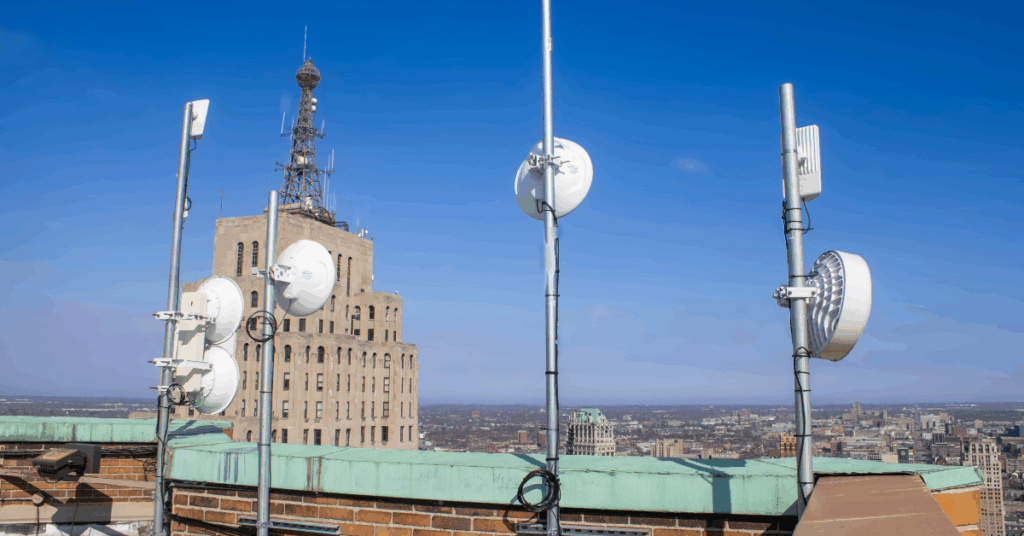
Detroit businesses are transforming operations through IoT connectivity solutions that enable real-time monitoring, automation, and data-driven decision-making. Business wireless internet infrastructure powers these connected systems, allowing manufacturers, logistics companies, and smart building operators to maximize efficiency while maintaining security.
Detroit’s Industrial IoT Revolution
The Motor City has evolved into a hub for smart manufacturing and connected operations. Detroit companies are deploying sensor networks across their facilities to monitor equipment health, track inventory movements, and optimize energy consumption. These systems rely on robust business wireless internet connectivity that can handle thousands of simultaneous device connections without compromising performance.
Manufacturing facilities in Metro Detroit are implementing predictive maintenance systems that reduce unplanned downtime by up to 30%. Warehouse operations use real-time tracking to improve fulfillment speeds. Building management systems automatically adjust HVAC and lighting based on occupancy patterns, cutting energy costs significantly.
The transformation extends beyond individual facilities. Companies are creating interconnected ecosystems where suppliers, distributors, and customers share data seamlessly. This level of connectivity demands enterprise-grade internet infrastructure with guaranteed uptime and low latency.
IoT Connectivity Requirements
Successful IoT deployments require network infrastructure that meets specific technical requirements. Bandwidth capacity must support simultaneous connections from hundreds or thousands of devices. Latency needs to stay below 5 milliseconds for real-time applications like robotics and automated guided vehicles.
Reliability is non-negotiable for business-critical IoT systems. Network uptime must reach 99.99% to prevent costly operational disruptions. Cronus provides fiber and fixed wireless solutions designed to meet these demanding requirements for Detroit businesses.
Security considerations are paramount when connecting operational technology to networks. Each IoT device represents a potential entry point for cyber threats. Network architecture must include segmentation, encryption, and continuous monitoring to protect against vulnerabilities.
Industry Applications in Detroit
Manufacturing Sensor Networks
Production lines integrate hundreds of sensors that monitor temperature, vibration, pressure, and other critical parameters. These sensors transmit data continuously to analytics platforms that identify anomalies before they cause equipment failures. Business wireless internet enables these sensor networks to function without the cost and complexity of running cables throughout massive manufacturing facilities.
Quality control systems use computer vision and AI to inspect products at speeds impossible for human operators. These systems generate enormous data volumes that require high-bandwidth connectivity for processing and storage in cloud platforms or edge computing systems.
Fleet Management Systems
Transportation and logistics companies track vehicle locations, fuel consumption, driver behavior, and maintenance needs in real time. GPS trackers, telematics devices, and onboard diagnostics systems communicate constantly with central management platforms.
Dispatch systems optimize routing based on real-time traffic conditions, delivery schedules, and vehicle availability. This connectivity reduces fuel costs, improves delivery times, and enhances customer satisfaction through accurate tracking information.
Smart Building Technology
Commercial buildings throughout Detroit are implementing IoT systems that control lighting, HVAC, security, and access systems. Occupancy sensors detect which areas are in use and adjust environmental controls accordingly, reducing energy waste during off-hours.
Building management systems collect data from thousands of sensors to identify maintenance needs before they become emergencies. HVAC systems schedule filter replacements based on actual usage rather than arbitrary time intervals. Security systems integrate video surveillance, access control, and intrusion detection into unified platforms.
Inventory Tracking Solutions
Warehouses and distribution centers use RFID tags, barcode scanners, and IoT sensors to track inventory movements with precision. Automated systems know exactly where every item is located and can direct workers to the most efficient pick paths.
Cold storage facilities monitor temperature and humidity continuously to protect perishable goods. Alert systems notify managers immediately if conditions drift outside acceptable ranges, preventing product loss.

Network Architecture for IoT
Effective IoT implementations require carefully designed network architecture. Segmentation separates IoT devices from core business systems to contain potential security breaches. VLANs create logical divisions that control traffic flow between different device groups.
Edge computing processes data locally to reduce latency and bandwidth consumption. Rather than transmitting every sensor reading to the cloud, edge devices perform initial analysis and send only relevant information. This approach reduces network congestion while enabling faster response times for time-critical applications.
Cronus delivers enterprise-grade connectivity through fiber optic and fixed wireless technologies that provide the bandwidth and reliability IoT systems demand. With speeds up to 100 Gbps and sub-5-millisecond latency, Detroit businesses can scale their IoT deployments without network constraints.
Security Considerations
IoT device security requires a multilayered approach. Network segmentation isolates IoT devices from sensitive business systems. Firewalls control traffic between segments based on strict rules that permit only necessary communications.
Device authentication ensures that only authorized hardware can connect to networks. Certificate-based authentication systems verify device identities before granting network access. Regular firmware updates patch vulnerabilities that attackers could exploit.
Continuous monitoring detects unusual traffic patterns that may indicate compromised devices. Security Information and Event Management systems correlate data from multiple sources to identify potential threats. The NIST Cybersecurity Framework provides comprehensive guidance for securing IoT deployments in industrial environments.
Cronus addresses cybersecurity challenges for Detroit businesses through network-level security controls, including DDoS protection, intrusion detection, and traffic filtering.
ROI Measurement & Analytics
Quantifying IoT investment returns requires tracking specific metrics. Energy management systems measure consumption reductions against baseline usage. Predictive maintenance calculates savings from avoided downtime and extended equipment life. Quality control systems count defects prevented through early detection.
Analytics platforms aggregate data from multiple sources to identify optimization opportunities. Machine learning algorithms detect patterns that humans might miss, such as subtle correlations between environmental conditions and equipment performance.
Dashboard visualization makes complex data accessible to decision-makers. Real-time displays show key performance indicators, allowing managers to spot trends and respond quickly to changing conditions. Historical analysis reveals long-term patterns that inform strategic planning.
IoT Connectivity FAQ
What internet speed do I need for IoT devices?
Speed requirements vary based on device types and quantities. Basic sensors transmitting small data packets may require only 100 Kbps per device. High-definition camera systems need 10-25 Mbps per camera. Total bandwidth requirements multiply with device count, so calculate based on your maximum simultaneous connections plus 20% overhead for growth.
How reliable does business wireless internet need to be for IoT?
Mission-critical IoT systems require 99.99% uptime, which translates to less than 1 hour of downtime per year. Production facilities, building management systems, and safety monitoring cannot tolerate extended outages. Business-grade service level agreements guarantee this reliability through redundant infrastructure and rapid response protocols.
What security measures protect IoT networks?
Effective IoT security includes network segmentation, device authentication, encryption, firewall rules, and continuous monitoring. Regular firmware updates patch vulnerabilities. Access controls limit which users can interact with devices. Intrusion detection systems identify unusual activity that may indicate attacks.
Can existing internet infrastructure support IoT expansion?
Many businesses discover their current connectivity cannot handle increased device counts. Older copper-based systems lack the bandwidth and reliability required for enterprise IoT. Upgrading to fiber or fixed wireless technology provides the capacity and performance needed for current deployments and future growth.
How does IoT connectivity differ from regular business internet?
IoT networks require higher device counts, lower latency, guaranteed uptime, and specialized security configurations compared to standard business internet. Quality of Service settings prioritize time-critical traffic. Network architecture separates IoT devices from other systems for security and performance optimization.
What role does 5G play in industrial IoT?
5G technology enables industrial IoT applications requiring ultra-low latency and high reliability. While not yet universally available, 5G will support mobile robots, autonomous vehicles, and real-time control systems that current technologies cannot adequately serve. Detroit businesses should plan infrastructure that can accommodate 5G integration as it becomes available.
Ready to power your Detroit business with enterprise-grade IoT connectivity? Contact Cronus to discuss fiber and fixed wireless solutions designed for demanding industrial applications. Trusted since 2008, we deliver the reliability and performance your smart operations require.