




Detroit businesses face unique connectivity challenges, from severe weather disruptions to infrastructure aging. Wireless internet for business backup solutions has become essential for maintaining operations during unexpected outages. Smart businesses implement comprehensive failover strategies that ensure seamless connectivity regardless of circumstances.
Modern wireless internet for business failover solutions provides the reliability Detroit companies need to thrive in an increasingly connected economy.
In today’s digital economy, internet downtime directly translates to revenue loss. Studies show that the average business loses $5,600 per minute during internet outages. For Detroit companies, implementing robust wireless internet for business backup systems isn’t optional—it’s critical for survival.
Why Detroit Businesses Need Internet Redundancy
Detroit’s infrastructure faces distinct challenges that make internet redundancy crucial. The city’s aging underground infrastructure, extreme weather patterns, and ongoing urban development create multiple points of potential failure.
Michigan’s winter weather poses significant risks to traditional internet infrastructure. Ice storms can damage overhead cables, while flooding affects underground fiber networks. Detroit businesses experienced this firsthand during the 2021 flooding that affected multiple telecommunications networks.
Power grid vulnerabilities create additional risks. When power outages occur, internet service providers’ equipment may fail even if your building has backup power. Wireless internet for business solutions provides independent connectivity that doesn’t rely on vulnerable infrastructure.
Construction and development throughout Detroit’s revitalization frequently lead to accidental cable cuts. Major projects in areas like the District Detroit and riverfront development zones occasionally disrupt fiber connections.
Smart Detroit businesses recognize that internet redundancy isn’t about IF an outage occurs—it’s about WHEN.
Companies with proper failover systems experience minimal disruption, while those without backup solutions face extended downtime and significant revenue losses.
Types of Failover Solutions
Modern failover solutions offer multiple approaches to maintaining connectivity during primary internet service disruptions. Understanding these options helps Detroit businesses choose the most appropriate backup strategy.
Cellular LTE Backup
Cellular backup represents the most common and accessible wireless internet for a business failover solution. LTE networks provide immediate connectivity when primary internet services fail.
Speed capabilities: Modern LTE networks in Detroit deliver 20-100 Mbps download speeds, sufficient for most business operations during outages. 5G networks, where available, can provide speeds exceeding 300 Mbps.
Cost effectiveness: Cellular backup typically costs $50-200 monthly for standby service, with usage-based charges during activation. This represents minimal expense compared to potential downtime costs.
Local businesses using professional wireless solutions report that cellular backup provides adequate performance for critical operations, including POS systems, VoIP phones, and essential cloud applications.
Diverse Fiber Routes
Diverse fiber routing involves establishing multiple physical pathways for internet connectivity. This approach provides maximum reliability but requires significant planning and investment.
Path diversity: Routes utilize different physical infrastructures to reach internet providers. One connection might use underground fiber while another uses aerial cables along different streets.
Provider diversity: Different internet service providers often use separate network infrastructures. If one provider experiences equipment failure, others remain operational.
Geographic separation: Routes physically separate from each other reduce risks from localized damage such as construction accidents or weather events.
Detroit’s growing fiber infrastructure makes diverse routing increasingly feasible. The city’s layout, with major thoroughfares like Woodward Avenue and Jefferson Avenue, provides natural separation for diverse fiber paths.
Satellite Backup Options
Satellite internet offers unique advantages for Detroit businesses requiring truly independent backup connectivity. Modern satellite services provide reliable performance unaffected by terrestrial infrastructure issues.
Weather independence: Unlike traditional assumptions, modern satellite services maintain connectivity during most weather conditions. Advanced signal processing minimizes weather-related disruptions.
Geographic coverage: Satellite service reaches any location within Metro Detroit, making it ideal for businesses in areas with limited terrestrial options.
Rapid deployment: Satellite installations typically require 1-2 weeks compared to months for fiber installations. This makes satellite excellent for temporary locations or quick deployment needs.
According to satellite industry experts, new low-earth orbit satellite constellations offer significantly improved performance compared to traditional geostationary satellite services.
Bonded Connections
Connection bonding combines multiple internet connections into a single, more reliable service. This approach provides both increased bandwidth and automatic failover capabilities.
Load distribution: Traffic spreads across multiple connections, improving overall performance while providing automatic backup functionality.
Seamless switching: When one connection fails, others automatically handle the full load without interrupting active sessions or applications.
Bandwidth aggregation: Multiple connections can work together to provide higher total bandwidth than any single connection offers.
Detroit businesses often bond cable internet with wireless internet for business connections to create robust, high-performance networks that maintain connectivity even during infrastructure problems.

Automatic vs Manual Failover
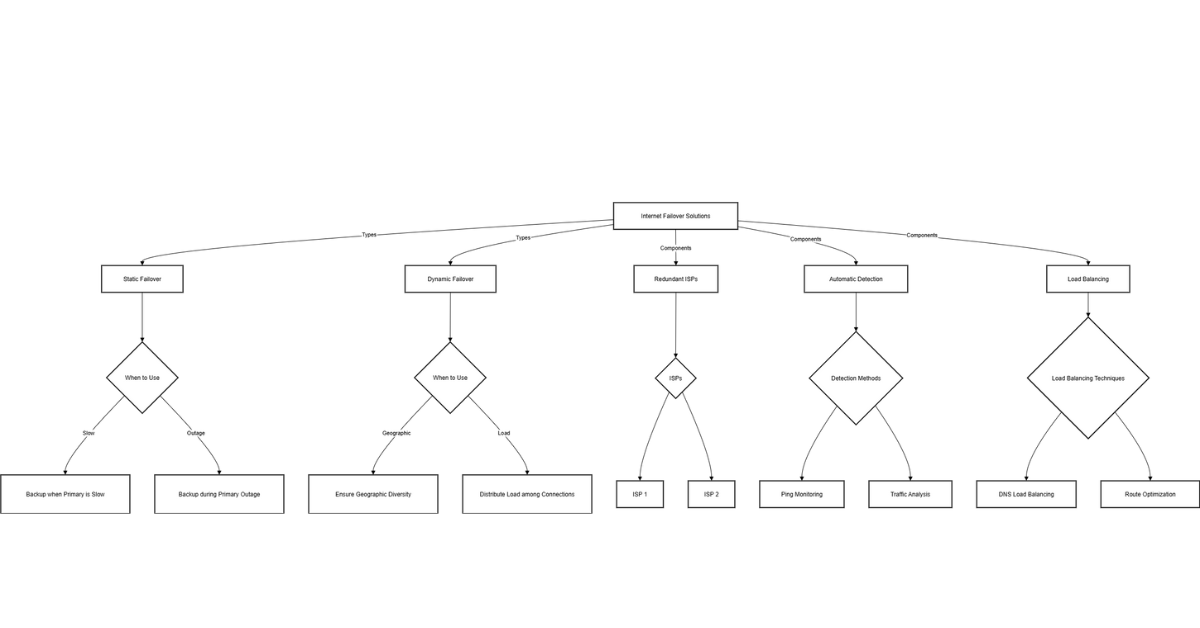
Failover systems can operate automatically or require manual intervention. Each approach offers distinct advantages depending on business requirements and technical capabilities.
Automatic failover provides an immediate response to connectivity issues. Systems continuously monitor primary connections and switch to backup services within seconds of detecting failures. This approach requires minimal human intervention but needs sophisticated monitoring and switching equipment.
Manual failover relies on human operators to initiate backup connections when primary services fail. While slower to respond, manual systems often cost less and provide greater control over switching decisions.
Most Detroit businesses benefit from automatic failover for critical connections while maintaining manual backup options for secondary systems. This hybrid approach balances cost, speed, and control.
Response time considerations: Automatic systems typically switch within 30-60 seconds, while manual switching might take 5-15 minutes. For businesses where every minute matters, automatic switching proves essential.
Cost implications: Automatic systems require additional equipment and monitoring services, typically adding 20-40% to backup connectivity costs. However, reduced downtime often justifies this investment.
Testing & Monitoring Your Backup
Regular testing ensures backup systems function properly when needed. Many businesses discover their failover systems don’t work only during actual emergencies—a costly mistake.
Monthly testing schedules verify backup connectivity and performance. Test sessions should include bandwidth measurements, application functionality, and switching speed verification.
Performance monitoring tracks backup system availability and performance trends. This data helps identify potential issues before they affect business operations.
Documentation updates ensure staff understand failover procedures and contact information remains current. Many backup system failures result from procedural issues rather than technical problems.
Detroit businesses working with experienced network providers often receive comprehensive testing and monitoring services as part of their wireless internet for business packages.
Industry-Specific Redundancy Needs
Different industries have varying requirements for internet redundancy. Detroit’s diverse economy demands tailored approaches for different business sectors.
Manufacturing companies require constant connectivity for IoT sensors, supply chain management, and quality control systems. Brief outages can halt production lines and affect quality metrics.
Healthcare organizations need uninterrupted connectivity for electronic health records, telemedicine, and patient monitoring systems. HIPAA compliance requirements often mandate redundant connectivity.
Financial services must maintain regulatory compliance and customer access to account information. Even brief outages can trigger regulatory scrutiny and customer complaints.
Retail businesses depend on POS systems, inventory management, and customer WiFi. Payment processing failures directly impact revenue and customer satisfaction.
Each industry benefits from customized wireless internet for business solutions designed around specific operational requirements and regulatory obligations.
Internet Failover FAQ
Q: How quickly do failover systems activate during outages?
A: Automatic failover typically activates within 30-60 seconds of detecting primary connection failure. Manual systems require 5-15 minutes, depending on staff availability and procedures. Wireless internet for business backup systems often provides the fastest activation times.
Q: What internet speed should I expect from backup connections?
A: Cellular LTE backup typically provides 20-100 Mbps, while 5G can exceed 300 Mbps. Satellite backup usually delivers 25-100 Mbps. Speed varies by location and network congestion levels.
Q: How much does internet failover cost for Detroit businesses?
A: Basic cellular backup costs $50-200 monthly plus usage charges. Comprehensive multi-path failover systems typically cost $300-800 monthly depending on bandwidth requirements and redundancy levels.
Q: Can backup systems handle VoIP phone systems?
A: Yes, most modern backup systems easily handle VoIP traffic. Quality wireless internet for business solutions provide sufficient bandwidth and low latency for clear voice communications during outages.
Q: How often should we test our failover systems?
A: Monthly testing ensures systems function properly. Quarterly comprehensive tests should include performance measurements and procedure verification. Annual reviews should evaluate changing business needs and technology updates.
Q: What happens to cloud applications during internet outages?
A: Cloud applications become inaccessible without internet connectivity. Failover systems restore access to critical cloud services, though some applications may require reconnection after switching to backup connections.
Q: Do I need different backup solutions for different locations?
A: Multi-location businesses often need customized solutions for each site. Factors like available infrastructure, local regulations, and operational requirements influence backup strategy selection for each location.
Don’t let internet outages disrupt your Detroit business operations. Contact Cronus Internet to design comprehensive wireless internet for business failover solutions that keep you connected when it matters most.