




































Updated October 2026 · For hotel owners, general managers and IT teams
Guests judge a hotel by its Wi-Fi almost as quickly as by its bed. Slow or unreliable internet shows up in reviews, frustrates business travelers and puts pressure on the front desk. The fastest way to fix it is to start with the connection into the building: fiber internet, paired with a well-designed managed Wi-Fi network.
This guide explains how fiber improves hotel Wi-Fi, what a modern hotel network looks like, and how to plan an upgrade without disrupting guests.
- Hotel Wi-Fi problems usually start with a shared, undersized connection into the building.
- Fiber gives hotels dedicated, symmetrical bandwidth for guests, meetings and operations.
- Managed Wi-Fi, separate secure networks and a backup connection matter as much as speed.
- Cronus delivers fiber and fixed wireless hotel internet in Detroit with 24/7 local monitoring.
Why Hotel Wi-Fi Struggles
Most hotel Wi-Fi complaints have the same causes: too little bandwidth shared by hundreds of devices, access points placed for an older building layout, and no one watching the network after hours. Evening peaks, when guests stream video in their rooms, expose every weakness at once.

How Fiber Internet Improves Hotel Wi-Fi
dedicated fiber brings guaranteed bandwidth into the hotel with equal upload and download speeds. That means video calls, cloud property-management systems, card payments and guest streaming all have room at the same time.
- Dedicated capacity: speeds do not drop when the neighborhood gets busy.
- Symmetrical speeds: fast uploads for video calls, cameras and cloud backups.
- Room to grow: upgrade bandwidth for events without new construction.
- Low latency: smoother voice, video and point-of-sale transactions.
What a Modern Hotel Network Includes
Fiber is the foundation, but guests feel the Wi-Fi design. A complete hotel network includes:
- Access points placed for coverage in rooms, hallways, lobby, pool and meeting space.
- A branded guest login page with optional tiers for premium speed.
- Separate secure networks for staff, point-of-sale, cameras and building systems.
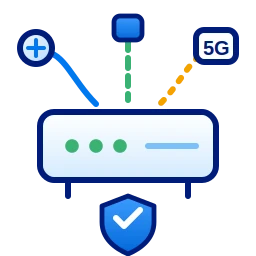
- Automatic backup through fixed wireless or 5G so guests stay online if a line is cut.
- 24/7 monitoring so problems are fixed before the front desk hears about them.
How Much Bandwidth Does a Hotel Need?
Bandwidth planning starts with peak demand, not average use. Count rooms, typical occupancy, meeting and event space, and back-office systems such as property management, point-of-sale, cameras and phones. Evening hours, when most guests stream video at once, usually set the peak.
As a starting point, select-service hotels often need several hundred megabits, while full-service and convention hotels commonly need one gigabit or more. Because fiber can be upgraded quickly, it is easy to add capacity for a large event and scale back afterward.
| Property type | Typical starting point |
|---|---|
| Boutique or select-service | 300 Mbps to 1 Gbps |
| Full-service hotel | 1 Gbps and up |
| Hotel with conference center | Multi-gigabit plus event bandwidth |
Wi-Fi for Meetings and Events
Conferences put the heaviest load on a hotel network: hundreds of attendees, presenters streaming video and vendors running payments, all in one room. Plan dedicated bandwidth and access points for meeting space, and offer event organizers their own network name and login page. Being able to promise reliable event Wi-Fi helps hotels win group business.
Protecting Guests and Hotel Systems
A hotel network carries guest traffic, payment card data and building systems. Keep them separate. Guests should be isolated from one another, point-of-sale systems should sit on their own secure network, and cameras and door locks should never share the guest Wi-Fi. A managed firewall and continuous monitoring add another layer of protection and help with payment security requirements.
Hotel Wi-Fi and Guest Reviews
Wi-Fi is one of the most frequently mentioned amenities in hotel reviews, and complaints about it are hard to recover from. Business travelers expect to join video calls from their rooms, families expect to stream in the evening, and every guest expects to connect without calling the front desk. Hotels that invest in their network see fewer complaints and more positive mentions, which supports direct bookings and higher rates.
The front desk feels the difference too. When the network is designed and monitored properly, staff spend less time troubleshooting guest devices and more time on service.
Fiber, Fixed Wireless or Both?
Fiber is the best foundation when it already reaches the property. Where it does not, or when construction would take months, fixed wireless can deliver fiber-class speeds in days. Many hotels use both: fiber as the main connection and fixed wireless as automatic backup on a separate path, so a cut cable never takes the hotel offline during a sold-out weekend.
| Setup | Strengths |
|---|---|
| Fiber only | High capacity, low latency |
| Fixed wireless only | Fast install, no construction |
| Fiber + fixed wireless | Maximum uptime with automatic failover |
Upgrading an Older Property
Older hotels often have thick walls, limited cable paths and equipment rooms in awkward places. A wireless survey shows exactly where coverage drops, and modern access points can often reuse existing cabling. Work is scheduled floor by floor, during low-occupancy periods, so guests stay connected throughout. After launch, monitoring data shows where to fine-tune coverage.
Planning a Hotel Wi-Fi Upgrade
- Survey the property and measure current coverage and usage.
- Size the internet connection for peak occupancy and events.
- Design access point placement and network segmentation.
- Install in phases, floor by floor, to avoid disrupting guests.
- Monitor and tune after launch.
Cronus provides hotel Wi-Fi solutions in Detroit, including properties like the Atheneum, with fiber and fixed wireless options and 24/7 local support.
Upgrade your hotel’s Wi-Fi
Get a property assessment and a clear plan from a local team.
Frequently Asked Questions
Is fiber internet worth it for a hotel?
For most hotels, yes. Fiber provides dedicated, symmetrical bandwidth that keeps guest Wi-Fi, meetings and hotel systems fast at peak times, and it can be upgraded as demand grows.
How much bandwidth does a hotel need?
It depends on room count, occupancy and events. Many full-service hotels need several hundred megabits to multi-gigabit connections. A survey of current usage gives the right number.
What if fiber is not available at my hotel?
Fixed wireless can deliver fiber-class speeds within days and is often used as the main connection or as automatic backup to fiber.
Can guests get a branded login page?
Yes. A managed hotel network can include a branded login page, optional paid tiers and separate secure networks for staff and systems.